
Selling quickly in Hudson County is not simply a question of finding the fastest buyer—it is a decision about how much time, certainty, effort, and potential equity you are willing to exchange for speed.
What’s the Best Way to Sell Your Property?
Answer 8 quick questions to see which selling path may best fit your property, timeline and priorities.
Your Seller Options Profile
Based on your answers, here’s a good place to start.
What happens next: A member of the T3 Home Buyers team may call or text you shortly to learn a little more about the property and answer any questions you have. There’s no obligation to sell.
This assessment is informational and is not an appraisal, legal advice, financial advice, or a guarantee that T3 Home Buyers will purchase a property.
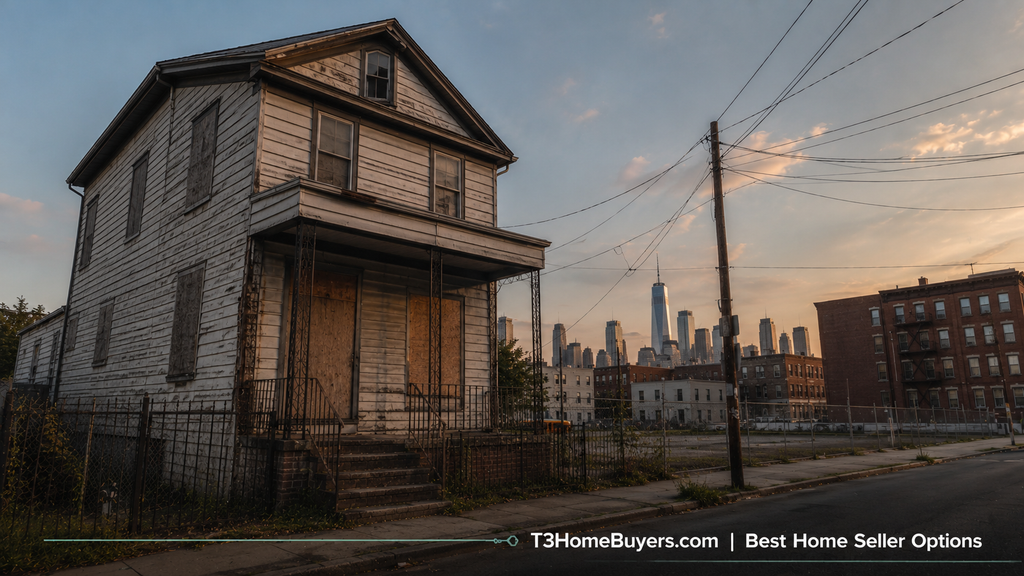
A homeowner in Hoboken with a renovated condominium may need a completely different strategy from the owner of a tenant-occupied two-family in Union City, an inherited property in Bayonne, or a Jersey City house requiring substantial repairs. That is why homeowners searching for “sell my house fast in Hudson County, NJ” should compare their probable net outcome, not just an advertised sale price.
Why Hudson County Requires a Local Selling Strategy
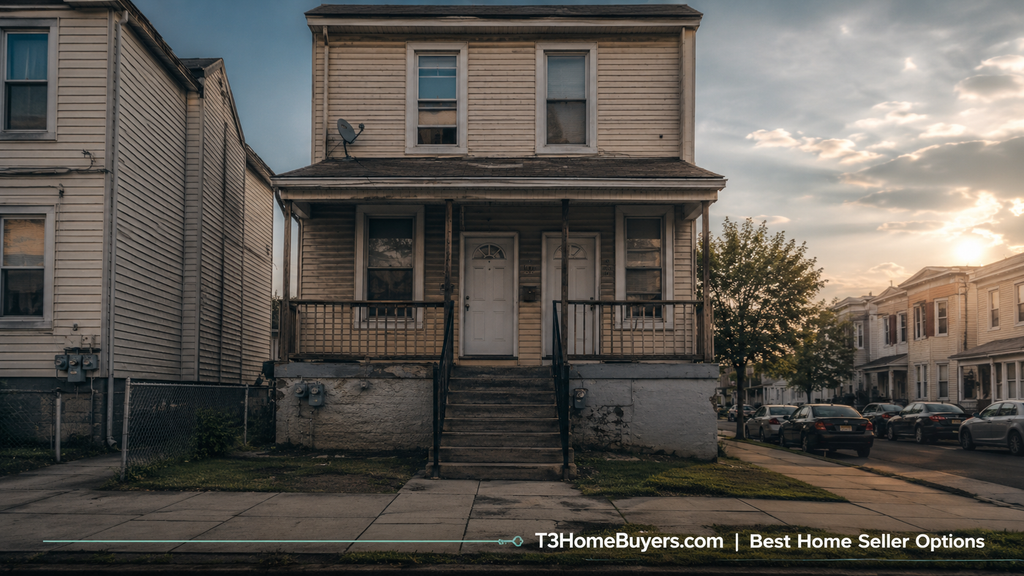
Hudson County combines dense urban neighborhoods, high-rise condominiums, older multifamily housing, brownstones, single-family properties, rental buildings, and redevelopment areas within a remarkably small geographic footprint.
The U.S. Census Bureau’s Hudson County QuickFacts estimated 735,033 residents as of July 1, 2025, compared with a 2020 estimates base of 724,863. The Census also reports a 30.7% owner-occupied housing rate for 2020–2024 and a median value of $539,700 for owner-occupied housing units during that period. These are countywide Census measures—not current MLS sale-price statistics—and should not be treated as a valuation for an individual property.
The county’s density is another defining characteristic. Census data reports 15,691.5 people per square mile in 2020. Hudson County’s proximity and transportation connections to Manhattan are part of its broader housing context, but individual properties can perform very differently depending on municipality, neighborhood, building type, condition, occupancy, parking, taxes, association considerations, and buyer financing.
That creates an important rule for sellers:
Do not confuse a county statistic with your property’s market value.
A credible selling strategy should be built from property-specific comparable sales, condition, legal use, occupancy, title, financing eligibility, municipal requirements, and current competition.
Hudson County Market Snapshot
| Indicator | Local Metric & Source |
|---|---|
| 2025 population estimate | 735,033 — U.S. Census Bureau |
| 2020–2024 owner-occupancy rate | 30.7% — U.S. Census Bureau |
| 2020–2024 median owner-occupied home value | $539,700 — U.S. Census Bureau; not a current sale-price metric |
| Current countywide median closed-sale price | Data unavailable from a sufficiently authoritative countywide MLS source verified for this guide |
| Current average days on market | Data unavailable from a sufficiently authoritative countywide MLS source verified for this guide |
| Current months of inventory | Data unavailable from a sufficiently authoritative countywide MLS source verified for this guide |
This distinction matters. Asking prices on real estate portals, automated valuations, Census home values, and closed-sale statistics are different measurements.

Your 4 Variables: Price, Time, Certainty, and Effort
Most sellers begin by focusing on price.
After more than two decades of navigating property transactions and changing real estate cycles, we have found that a more useful framework is to evaluate four variables simultaneously:
Price: What might a qualified buyer reasonably pay?
Time: How long can you comfortably wait?
Certainty: How damaging would a failed transaction be?
Effort: How much repair work, cleaning, showing preparation, paperwork, tenant coordination, or negotiation are you prepared to handle?
There is rarely one selling method that maximizes all four.
A traditional market sale may expose the property to a larger buyer pool and create greater price competition, but it can require preparation, showings, inspections, appraisal and financing.
An as-is investor or cash transaction can reduce some of those steps and potentially shorten the process, but convenience has economic value. Sellers should therefore compare the cash offer with a realistic estimate of what they could net through other routes.
Comparing Your Main Selling Paths
| Strategy | Timeline & Effort | Potential Net-Equity Impact |
|---|---|---|
| Traditional market listing | Usually more preparation and transaction steps | May maximize market exposure; selling expenses must be deducted |
| List as-is | Less repair work while retaining market exposure | Buyer may discount for condition and uncertainty |
| Direct cash/as-is sale | Potentially fewer financing and repair contingencies | Convenience and risk transfer may result in a lower price |
| Repair before selling | Requires capital, contractors and time | Improvements may increase appeal, but returns are not guaranteed |
| Retain or rent | No immediate sale; ongoing management obligations | Preserves ownership but retains operating and market risk |
There is no universally superior answer.
A $20,000 repair does not automatically create $20,000—or more—in additional net proceeds. Conversely, accepting a substantial discount solely to avoid relatively inexpensive repairs may sacrifice equity unnecessarily.
Run the numbers before choosing the method.
What “Cash Offer” Should Actually Mean to a Seller
The phrase cash offer is often treated as synonymous with “fast” and “guaranteed.”
It should not be.
A serious seller should determine:
- Who is actually purchasing the property?
- Is there proof of funds?
- Is the contract assignable?
- Are there inspection or cancellation provisions?
- Is the buyer requesting an unusually long due-diligence period?
- Are there hidden fees or credits?
- Who selects the title or closing professionals?
- What happens if the buyer does not close?
- Is the advertised price actually the amount shown in the contract?
The useful comparison is not:
Cash offer versus listing price.
It is:
Cash net proceeds versus realistic market-sale net proceeds, adjusted for time, repairs, carrying costs, transaction risk, and inconvenience.
Selling As-Is Does Not Mean Ignoring Known Problems
“As-is” generally means the seller does not intend to make negotiated repairs. It does not automatically eliminate disclosure obligations or allow known material defects to be concealed.
New Jersey’s official Seller’s Property Condition Disclosure Statement states that a seller is obligated to disclose known material defects even when a particular issue is not addressed on the printed form.
This becomes particularly important with older Hudson County properties, where questions may involve roofs, plumbing, electrical systems, water intrusion, environmental concerns, additions, multifamily use, or prior repairs.
Sellers should obtain legal advice when they are uncertain about a disclosure obligation.
Multifamily and Rental Properties Need Another Layer of Due Diligence
Hudson County sellers frequently deal with properties containing tenants or multiple dwelling units.
That can introduce questions involving leases, security deposits, rent records, municipal registrations, certificates, permitted use, lead compliance, and the buyer’s intended occupancy.
New Jersey’s Department of Community Affairs lead-based paint guidance states that certain single-family, two-family, and multiple rental dwellings are subject to periodic lead-based-paint-hazard inspections. The state also requires owners to provide specified lead-related documents, including applicable lead-safe certifications, to prospective owners during a real estate transaction, settlement, or closing.
This is an area where assumptions can become expensive.
Before marketing an older rental property, determine what records exist and which state and municipal requirements apply to that specific building.
New Jersey Closing Costs Can Change the Net-Proceeds Calculation
A high offer is not necessarily the best offer if its expenses, credits, contingencies, or delays produce a weaker bottom line.
New Jersey imposes a Realty Transfer Fee when qualifying deeds are recorded. The New Jersey Division of Taxation’s Realty Transfer Fee guidance states that the seller is responsible for the Realty Transfer Fee, subject to applicable exemptions. The state changed the treatment and graduated fee structure affecting certain transfers above $1 million effective for qualifying transfers occurring on or after July 10, 2025, so sellers—particularly those dealing with higher-value Hudson County property—should obtain a transaction-specific calculation rather than relying on an old “mansion tax” rule of thumb.
Depending on the transaction, seller-side calculations can also involve attorney fees, brokerage compensation if applicable, mortgage payoff amounts, liens, negotiated buyer credits, title-related issues, municipal requirements, prorations, and other closing adjustments.
Ask for a seller net sheet before comparing offers.
When Repairs May—or May Not—Make Financial Sense
Repairs are investments, not guarantees.
Consider three questions:
Will the repair materially increase the buyer pool?
A condition that prevents conventional financing can matter more than a cosmetic improvement.
Will the improvement plausibly return more than its total cost?
Include permits, contractors, financing, carrying time, cleanup, and unexpected overruns.
Do you have enough time for the project?
A theoretically profitable renovation may still be the wrong strategy when a seller has a foreclosure deadline, relocation, inherited-property expenses, tenant problem, divorce-related deadline, or other time constraint.
In our 20+ years of navigating real estate cycles, one recurring mistake is treating every dollar spent before a sale as though the market must reimburse it. Buyers determine value—not renovation receipts.
Pre-Foreclosure in Hudson County: Time Becomes an Asset
If you have received foreclosure notices, a complaint, final judgment, or notice of sheriff’s sale, this is no longer merely a marketing decision.
It is a deadline-management problem.
New Jersey uses a judicial foreclosure process. The New Jersey Courts foreclosure resource explains that eligible homeowners can request foreclosure mediation and warns that lenders may continue pursuing the foreclosure while mediation is underway. The Judiciary advises homeowners to request mediation as soon as possible after receiving a notice of foreclosure.
According to the Judiciary’s foreclosure self-help information, after final judgment the court can issue a writ of execution directing the county sheriff to sell the property. The Judiciary states that the sheriff has 150 days from the writ of execution to auction the property and describes statutory stays and other possible relief depending on the circumstances. It also states that a debtor generally has a 10-day redemption period after the sale.
Those procedural rights should never be interpreted as extra time you can safely waste.
If enough equity exists, selling before the foreclosure reaches its final stages may sometimes provide a way to satisfy the mortgage and other valid liens while preserving remaining equity. Whether that is possible depends on the actual payoff, liens, property value, contract terms, closing timeline, and foreclosure status.
Homeowners in foreclosure should communicate with their mortgage servicer and obtain qualified legal or HUD/NJHMFA-approved housing counseling assistance. Selling is only one potential path.
Take the Home Seller’s Options 2-Minute Quiz
Inherited Properties and Estate Sales
Inherited Hudson County real estate can present a different set of complications:
- multiple heirs;
- probate or estate administration;
- an existing mortgage;
- unpaid property expenses;
- deferred maintenance;
- occupants or tenants;
- personal property left inside;
- disagreement over whether to sell or retain the property.
Before spending heavily on renovation, determine who has authority to sell and whether title can be conveyed.
An inherited property with excellent underlying value may need only cleaning and strategic marketing. Another may contain enough deferred maintenance that an as-is transaction deserves serious consideration.
Do not choose the renovation strategy before understanding the legal and financial picture.
Liens, Open Issues, and Title Problems
A fast closing requires more than a willing buyer.
Outstanding mortgages, judgments, tax issues, estate matters, ownership discrepancies, municipal issues, or other title defects can slow or prevent closing.
For that reason, sellers who know a property has complications should consider beginning title and payoff research early rather than discovering a problem days before the expected closing.
Speed is created through preparation as much as through marketing.
Municipal Requirements Can Differ Across Hudson County
Hudson County includes multiple municipalities, and sellers should not assume that a requirement in Jersey City is identical to one in Bayonne, Hoboken, North Bergen, Kearny, Union City, Secaucus, or another municipality.
Depending on the property and municipality, a transaction can raise questions about certificates, inspections, fire or smoke requirements, zoning or legal use, rental registration, open permits, lead documentation, and local procedures.
Verify the rules for the municipality and property type involved rather than relying on a generic county checklist.
How to Calculate the Real Cost of Waiting
Suppose one option promises a higher sale price but requires months of additional ownership.
That difference should be tested against:
Mortgage + property taxes + insurance + utilities + association fees + maintenance + repairs + selling expenses + risk of price changes + value of your time.
Do not automatically assume the faster offer wins.
Do not automatically assume the higher offer wins either.
The objective is to compare probable net proceeds and execution risk.
A Better Way to Evaluate Competing Offers
When reviewing offers, create a simple comparison for each one:
| Question | What to Compare |
|---|---|
| What do I actually receive? | Price minus seller expenses, credits and concessions |
| How certain is closing? | Financing, appraisal, inspection and cancellation terms |
| How much work remains? | Repairs, cleanout, showings and documentation |
| How valuable is the timing? | Carrying costs, deadlines and personal circumstances |
| What happens if it fails? | Lost time and financial consequences |
A slightly lower offer with materially stronger terms can sometimes produce a better result.
Likewise, an extremely fast offer may not justify a major equity discount when the seller has enough time to expose the property to competing buyers.
Take the Home Seller’s Options 2-Minute Quiz
High-Leverage Questions to Ask Before You Sell
Before signing a listing agreement or purchase contract, ask:
What is my realistic as-is market value?
Not an automated estimate. Not the highest neighboring asking price. A property-specific assessment based on relevant sales and current competition.
What would I realistically net from a traditional sale?
Subtract expected transaction costs, repairs, concessions, carrying expenses, and other seller obligations.
What would I net from an as-is or cash sale?
Look beyond the headline offer.
How much is speed worth to me?
For some sellers, two extra months are manageable. For someone approaching a foreclosure sale or carrying an expensive vacant property, they may not be.
Which risks am I transferring to the buyer?
Repair risk, appraisal risk, financing risk, cleanout obligations and timing certainty all have economic value.
Can the buyer actually perform?
Ask for appropriate evidence.
What happens if I choose the wrong strategy?
This is particularly important when a legal, foreclosure, relocation, probate, or financial deadline exists.
The Bottom Line for Hudson County Sellers
If your goal is to sell your house fast in Hudson County, NJ, speed should be treated as one variable—not the entire strategy.
A strong decision compares:
probable sale price + probable expenses + carrying costs + required work + closing certainty + available time.
Hudson County’s diverse housing stock makes blanket advice especially risky. A condominium, brownstone, two-family rental, inherited house, distressed property, and renovated single-family home should not automatically follow the same path.
Start with the numbers. Identify your deadline. Understand the property’s condition and legal status. Then compare the options based on what you are likely to keep—not merely what someone promises to pay.
Frequently Asked Questions
The fastest practical route depends on the property and your deadline. Options can include competitively pricing a traditional listing, marketing the property as-is, or considering a direct cash purchaser. Compare estimated net proceeds and contract certainty before choosing solely on speed.
An as-is sale is possible, but “as-is” does not automatically eliminate disclosure obligations. Known material defects and transaction-specific legal requirements should be discussed with a qualified New Jersey real estate attorney.
Not necessarily. Cash eliminates lender underwriting, but the contract may still contain inspections, due-diligence periods, title requirements, or cancellation rights. Examine the actual contract rather than relying on the word “cash.”
About Repairs
Only when the likely improvement in your selling outcome reasonably justifies the cost, time, and risk. Obtain an as-is valuation before undertaking expensive renovations.
A sale may be possible before completion of foreclosure if the transaction can close in time and satisfy the necessary payoff and liens. Because foreclosure involves strict legal procedures and deadlines, immediately consult the mortgage servicer and qualified legal or housing-counseling professionals. New Jersey Courts provides official foreclosure and mediation information.
New Jersey Courts explains that after final judgment and issuance of a writ of execution, the county sheriff is directed to sell the property. Specific stays and other options can apply, and the Judiciary publishes procedures for homeowners. Do not rely on a generalized timeline for an individual case.
New Jersey imposes a Realty Transfer Fee on qualifying property transfers, generally imposed on the seller, subject to exemptions and transaction-specific rules. Higher-value transfers can also fall under the state’s graduated fee provisions. Obtain a current calculation for the specific transaction.
How Soon Can You Sell?
A reliable current countywide days-on-market figure from an authoritative MLS source was not established for this guide. Conditions vary substantially by municipality, neighborhood, property type, price range, condition, and financing eligibility.
They can require additional planning because leases, tenant rights, security deposits, rental documentation, lead requirements, inspections, and buyer intentions can affect the transaction. Review the specific property before establishing a closing timeline.
Compare it with a credible as-is market valuation and a realistic traditional-sale net sheet. Then assign value to the repairs, carrying costs, contingencies, time, and transaction risk the cash purchaser is eliminating.
Treating urgency as a reason to stop comparing options. A deadline should make your analysis faster and more disciplined—not eliminate it.
Educational information only. Real estate, foreclosure, taxation, landlord-tenant, probate, and title issues can be fact-specific. Consult appropriately licensed professionals regarding your circumstances.